
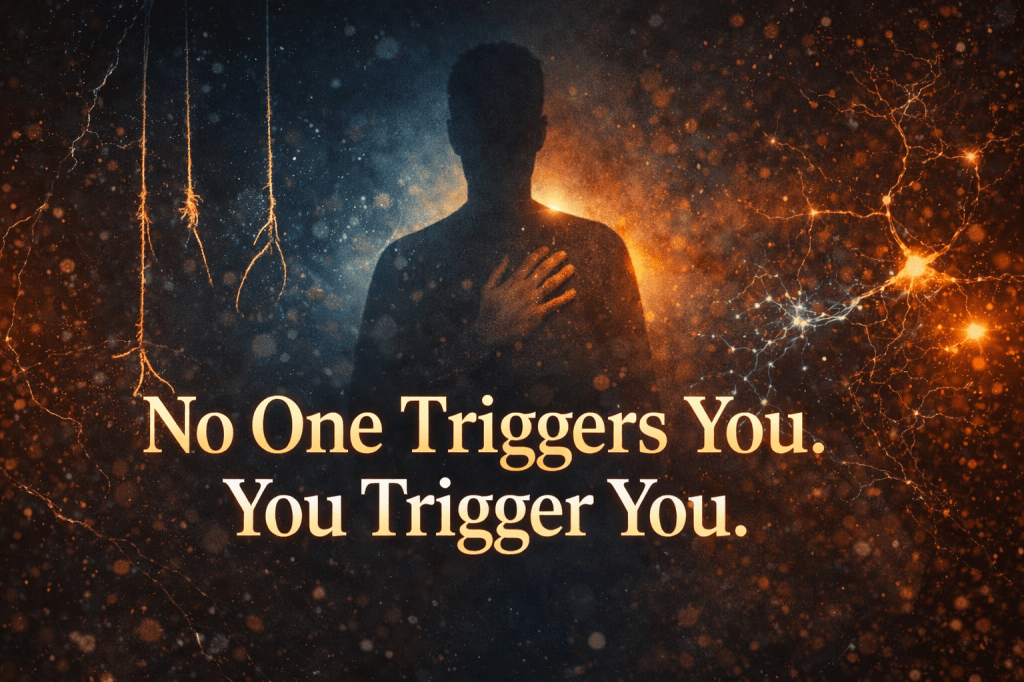
The uncomfortable truth that sets you free
You’ve heard it before.
“People trigger me.”
“My boss triggers me.”
“My ex triggers me.”
“My family triggers me.”
Sounds logical. Feels true.
But it’s not the full truth.
A trigger is not something someone does to you.
A trigger is something your nervous system does with what happens.
Same event. Two people.
One stays calm.
The other explodes inside.
So what’s the difference?
Your interpretation.
Your memory.
Your body’s stored stress response.
Your inner rules about what “should” happen.
That’s why this message is brutal.
And liberating.
Because the moment you see you’re the one creating the reaction…
You get your power back.
What a trigger really is
A trigger is a fast emotional spike.
Anger. Shame. Fear. Disgust. Panic. Collapse.
It hits before you think.
Triggers are not “random.”
They follow a pattern.
A trigger is your brain screaming:
“Danger. This feels like the past.”
Even if the present is not the past.
Your system detects a familiar emotional threat, then launches protection mode.
Protection mode looks like this:
- Fight: you argue, attack, dominate
- Flight: you avoid, disappear, procrastinate
- Freeze: you shut down, go numb
- Fawn: you people-please, over-explain
So the trigger is not the person.
The trigger is your internal alarm system.
“Nothing is being done to you” feels harsh, but it’s gold
When you believe people “do” emotions to you, you become reactive.
You become a puppet on someone else’s string.
When you realize your reaction is created inside you, you become dangerous in the best way.
You become unshakable.
Not because life gets softer.
Because you get cleaner.
Here’s the key:
The event is neutral.
Your meaning creates the stress.
Example:
Someone doesn’t reply for hours.
Event: silence.
Meaning 1: “They’re busy.” Calm.
Meaning 2: “I’m not important.” Spiral.
Meaning 3: “They’re disrespecting me.” Rage.
Same silence.
Different inner story.
That story triggers your body.
The real trigger is the sentence in your head
Most triggers have a hidden sentence behind them.
You won’t notice it at first.
Because it runs fast.
Common trigger sentences:
- “I’m not respected.”
- “I’m invisible.”
- “I’m not safe.”
- “I’m not enough.”
- “I’m losing control.”
- “I’m being rejected.”
- “People always take from me.”
- “I must prove myself.”
That sentence hits, your body reacts, then your mind searches for evidence.
So you feel “triggered by them.”
But you were triggered by your own internal meaning.
Your body triggers you too
Triggers are not only mental.
They’re physical.
Your body can fire the reaction first:
- tight chest
- jaw clench
- stomach drop
- throat closes
- heat in face
- tunnel vision
- shaky hands
Your body learned:
“Last time this happened, pain followed.”
So now it reacts before you choose.
That’s why talking yourself out of a trigger often fails.
Because your body is already in survival mode.
You need a body reset, not a motivational speech.
“No one to blame” does not mean “accept abuse”
Let’s be clear.
Taking responsibility for your trigger does not mean:
- you tolerate disrespect
- you stay in toxic situations
- you ignore boundaries
- you excuse bad behavior
It means you stop being controlled by your reaction.
You can hold people accountable.
Without losing your nervous system.
That’s mastery.
Extreme stress is universal. Your relationship with it is personal.
Stress happens to everyone.
Bills. grief. conflict. loneliness. pressure. health.
The only real question is this:
Do you use stress, or does stress use you?
Stress becomes fuel when you lead it.
Stress becomes poison when you loop it.
Most people don’t suffer from stress alone.
They suffer from stress plus mental repetition.
They replay.
Rehearse.
Predict.
Catastrophize.
Fight imaginary battles.
That creates stress on top of stress.
So your job is simple:
Stop adding the second layer.
The Trigger Flip Method (fast, practical, brutal)
Use this when you feel the spike.
Step 1. Name the trigger without drama
Say:
“I’m triggered.”
Not “They’re ruining my day.”
Not “I hate this.”
Just facts.
Naming interrupts possession.
Step 2. Identify what you told yourself
Ask:
“What did I just make this mean?”
Write the first sentence that appears.
Examples:
- “I’m not valued.”
- “I’m being controlled.”
- “I’m about to be abandoned.”
Step 3. Find the body move
Ask:
“What did my body do?”
Examples:
- “I held my breath.”
- “My shoulders lifted.”
- “My throat tightened.”
Your body is your dashboard.
Step 4. Choose a new command
Use one line:
- “I’m safe right now.”
- “This is discomfort, not danger.”
- “I don’t chase respect, I require it.”
- “I respond slow, not fast.”
Short. Direct. Repeatable.
Step 5. Do the 20-second reset
Pick one:
- exhale longer than inhale for 6 breaths
- unclench jaw, drop tongue from roof of mouth
- press feet into floor, feel the ground
- relax shoulders on every exhale
You’re teaching your system a new default.
The 3 hidden reasons you stay triggerable
1) You think emotion equals truth
Emotion is information.
Not a verdict.
Feeling rejected does not mean you’re being rejected.
Feeling unsafe does not mean danger is present.
2) You confuse boundaries with control
A boundary is “I won’t stay here.”
Control is “You must change.”
Boundaries give you peace.
Control keeps you triggered.
3) You avoid the core wound
Most triggers are old pain wearing a new mask.
Disrespect often hides old shame.
Abandonment fears often hide old grief.
Anger often hides powerlessness.
Your trigger is a messenger.
Not an enemy.
A simple “Trigger Audit” you can do today
Take one recent moment you got triggered.
Answer these:
- What happened, in one sentence.
- What did I make it mean.
- What emotion hit first.
- Where did I feel it in my body.
- What did I do next.
- What did I need in that moment.
- What would the strongest version of me do next time.
Do this 5 times.
Patterns will slap you in the face.
That’s progress.
The real freedom is response-ability
You don’t control life.
You control your response.
And when you control your response, you control your results.
You stop bleeding energy into pointless conflict.
You stop spiraling for days.
You stop handing strangers remote control over your mood.
You become the person who feels the spike…
Then chooses.
That’s how you stop being enslaved by a pattern.
And return to your own command.
Micro practices for becoming untriggerable
Do one per day. No excuses.
Practice 1: The Pause Muscle
Before replying, count 3 breaths.
Every time.
Practice 2: The “So What” Cut
Ask: “So what does this change in my life today?”
If answer is “nothing,” release it.
Practice 3: The Respect Line
Say: “I’m available for calm conversations only.”
Then stop talking.
Practice 4: The Nervous System Cleanout
Walk 10 minutes. No phone.
Let your body finish the stress cycle.
Practice 5: The Identity Shift
Instead of “I get triggered,” say:
“I’m learning to respond.”
Words shape your default.
You don’t need less stress. You need more leadership.
Life will pressure you.
People will disappoint you.
Your past will knock sometimes.
But none of that has to own you.
When you stop blaming the outside…
You stop feeling powerless.
And when you stop feeling powerless…
Your whole life changes.
Not because the world behaves better.
Because you do.
“No one triggers you. They reveal the button you forgot you installed.”


 Quantum-Coaching
Laisser un commentaire