
The hidden message behind physical symptoms
Your body has no talent for bullshit.
Your mind negotiates.
Your ego explains.
Your mouth says, “I’m fine.”
Your body says, “Cute story, bro. Here’s a migraine.”
That is the point most people miss.
A symptom is not always some deep spiritual telegram from the universe. Sometimes your neck hurts because you slept like a folded lawn chair. Sometimes your stomach hurts because you ate something your intestines filed a formal complaint against.
But when the same symptom keeps showing up around the same emotion, person, pattern, memory, pressure, or life situation, pay attention.
The body keeps receipts.
Stress has known physical effects, including headaches, muscle tension, chest pain, fatigue, stomach upset, sleep problems, and changes in sex drive. It also affects mood and behavior, including anxiety, irritability, overeating, undereating, and withdrawal. Cleveland Clinic describes psychosomatic symptoms as real physical symptoms influenced or worsened by mental stress and distress.
So the cleanest way to see this is simple.
The symptom is the body signal.
The emotional pattern is the message.
The change you make is the answer.
First, respect the medical layer
Let’s keep this grounded.
Chest pain, fainting, sudden weakness, severe pain, blood, fever, shortness of breath, or fast decline belongs in the medical lane first. No debate. No spiritual gymnastics. No “my soul is releasing grief” while your body is waving a red flag.
The NHS says urgent help is needed for sudden chest pain or discomfort that does not go away, chest pain spreading to the arms, neck, jaw, stomach, or back, or chest pain with sweating, nausea, lightheadedness, or shortness of breath.
Handle the body.
Then read the pattern.
That is the mature path.
The body does not whisper forever
Most people ignore the first signs.
The tight jaw.
The tired eyes.
The stomach turning before a meeting.
The headache after talking to one specific person.
The lower back screaming every time money stress rises.
The skin flare after another week of swallowing irritation.
At first, the body whispers.
Then it knocks.
Then it kicks the damn door in.
This is where body awareness becomes useful. You stop asking, “How do I shut this down?” and start asking, “What pattern keeps lighting this up?”
That question changes everything.
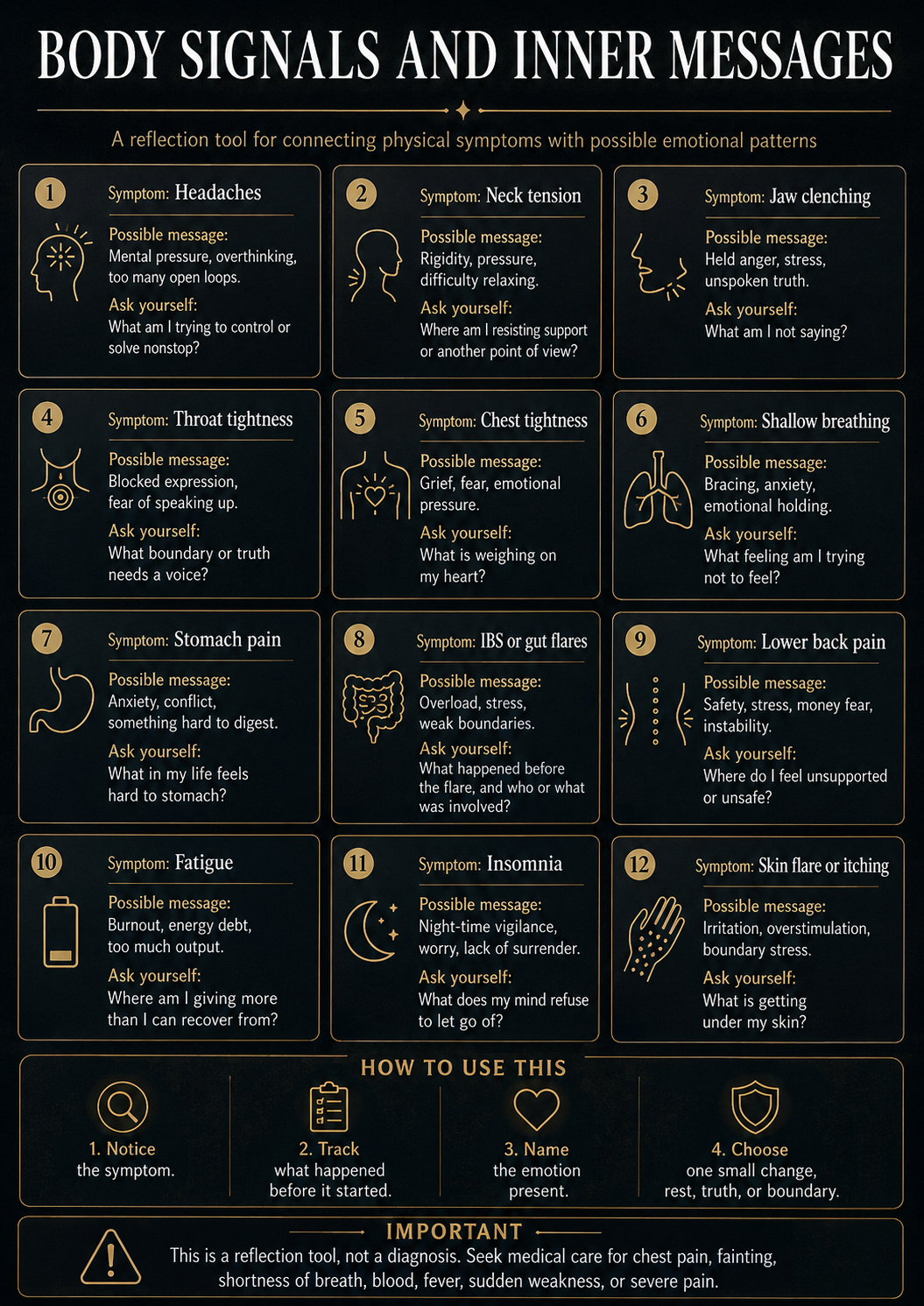
Headaches, mental pressure with a skull soundtrack
A headache often appears when your mind has too many tabs open and every tab is playing a different disaster movie.
You are thinking too much.
Fixing too much.
Predicting too much.
Controlling too much.
The possible emotional message:
You are trying to solve something nonstop instead of simplifying, deciding, resting, or letting go.
Ask yourself:
What thought keeps circling?
What problem am I trying to control?
What decision am I delaying?
What part of my life needs less pressure?
A headache often points to overload. Sometimes the answer is water, sleep, food, medication, or medical care. Sometimes the answer is closing the mental circus.
Often, both matter.
Neck tension, the body version of “I refuse”
The neck turns the head. So when it locks, the symbolism is almost too obvious.
Something in you does not want to look another way.
That might mean stubbornness. It might mean pressure. It might mean self-protection. It might mean you have carried the same posture of survival for years and your body is sick of the pose.
The possible emotional message:
You are holding too tightly to one role, one opinion, one burden, or one defense.
Ask yourself:
Where am I resisting help?
Where am I refusing another point of view?
Where am I trying to stay strong instead of supported?
What would happen if I softened my stance by ten percent?
Neck tension often belongs to people who live like the whole planet collapses if they relax.
Spoiler, it usually doesn’t.
Jaw clenching, rage in a nice little cage
Jaw tension is one of the loudest signs of suppressed truth.
Your mouth stays polite.
Your jaw starts doing CrossFit.
This is the body saying, “There is a sentence in here and you keep sitting on it.”
The possible emotional message:
Anger, resentment, truth, or boundaries are being held back.
Ask yourself:
What am I not saying?
Who am I pretending not to resent?
Where did I say yes when my body meant no?
What honest sentence would release pressure?
Jaw clenching often shows up in people who learned to stay “reasonable” while their insides were screaming.
Reasonable has its place.
So does truth.
Throat tightness, when the voice gets locked in the basement
A tight throat often points to blocked expression.
It shows up when you need to speak and swallow the words instead. It shows up when the truth feels dangerous. It shows up when love, fear, anger, or grief tries to rise and meets an old rule that says, “Shut up, stay safe.”
The possible emotional message:
Your voice needs space.
Ask yourself:
What truth needs a voice?
What boundary needs words?
Where do I edit myself to stay accepted?
What did I learn would happen if I spoke clearly?
The throat does not always demand a speech.
Sometimes it asks for one clean sentence.
“No.”
“That hurt.”
“I need help.”
“I disagree.”
“I am done pretending.”
Short truth beats elegant self-betrayal.
Chest tightness, emotional pressure behind the armor
The chest is sacred territory. So respect the medical layer first.
After that, chest tightness often points toward grief, fear, pressure, heartbreak, or emotional load. This is the place where people store things they claim they already “handled.”
Handled often means buried.
Buried often means waiting.
The possible emotional message:
Something is weighing on your heart.
Ask yourself:
What grief have I avoided?
What fear sits under the pressure?
Where am I carrying emotional weight alone?
What would my heart say without the armor?
Some people do not need more motivation.
They need a safe place to fall apart for ten minutes without turning it into a productivity exercise.
Shallow breathing, your system waiting for impact
Shallow breathing is the breath of bracing.
It says, “Stay ready.”
It says, “Do not fully land here.”
It says, “Something might happen.”
A body stuck in stress mode rarely breathes like life is safe. It breathes like danger is around the corner wearing a fake mustache.
The possible emotional message:
Your nervous system is guarding against a feeling, situation, memory, or threat.
Ask yourself:
What feeling am I trying to avoid?
Where do I hold my breath in daily life?
What situation makes my body brace?
What would make this moment feel one percent safer?
Breathwork is useful when it meets reality.
A deep breath does not erase a toxic life. But it gives your nervous system a crack in the door.
Then you still have to change something.
Stomach pain, the gut calling bullshit
The gut is savage.
It reacts to food, inflammation, infection, hormones, medication, stress, sleep, and your life choices. Sometimes all in the same week, because apparently the human body loves group projects.
On the emotional layer, stomach pain often shows up when something feels hard to digest.
A conversation.
A betrayal.
A decision.
A truth.
A relationship.
A situation you keep forcing yourself to accept.
The possible emotional message:
Something in your life feels wrong for your system.
Ask yourself:
What feels hard to stomach?
Who makes my gut tighten?
What am I forcing myself to accept?
What situation do I keep explaining away?
Your gut is not a flawless prophet.
But it is a damn good informant.
IBS and gut flares, overload with consequences
Gut flares need practical tracking.
Food.
Sleep.
Stress.
Medication.
Inflammation.
Timing.
Hormones.
Illness.
Social pressure.
The emotional layer becomes clear when the flare follows a pattern.
After conflict.
After over-giving.
After fear.
After pressure.
After seeing someone.
After ignoring your own no.
The possible emotional message:
Your system has passed its tolerance line.
Ask yourself:
What happened before the flare?
Who was involved?
What emotion was present?
What boundary got crossed?
What did I accept while my body protested?
This is where a symptom journal becomes gold.
Not a diary full of “dear universe” glitter.
A simple pattern tracker.
Date.
Symptom.
Food.
Sleep.
Stress level.
People involved.
Emotion present.
What helped.
That gives you evidence. Evidence gives you power.
Lower back pain, survival stress in the foundation
Lower back pain has many physical causes. Muscles, discs, posture, movement, weight load, inflammation, injury, and daily habits matter.
On the symbolic and emotional layer, lower back pain often connects to survival themes.
Money.
Home.
Safety.
Support.
Stability.
Feeling alone with too much life.
The possible emotional message:
Your foundation feels threatened.
Ask yourself:
Where do I feel unsupported?
What money fear keeps returning?
What part of my life feels unstable?
Where do I need structure instead of hope?
The lower back often does not want a vision board.
It wants a plan.
A budget.
A calendar.
A phone call.
A boundary.
A better chair.
A walk.
A doctor.
A damn break.
Grounding is not mystical if your basic life is on fire.
Fatigue, the invoice for over-functioning
Fatigue is often treated like a character flaw.
Lazy.
Weak.
Unmotivated.
Undisciplined.
Cute. Also wrong.
Fatigue often appears after long periods of pushing beyond recovery. Chronic stress is linked with fatigue, digestive problems, headaches, muscle tension, sleep problems, weight gain, and problems with memory and focus.
The possible emotional message:
You are in energy debt.
Ask yourself:
Where am I giving more than I recover from?
What drains me every week?
What am I doing to look functional?
Which obligation costs more than I admit?
Fatigue does not always ask for more ambition.
Sometimes it asks for subtraction.
Less noise.
Less people-pleasing.
Less pretending.
Less output.
Less proving.
Recovery is not laziness. It is debt repayment.
Insomnia, the mind doing unpaid night security
Insomnia often turns the mind into a night guard with trust issues.
It reviews every mistake.
It rehearses every possible disaster.
It starts arguments with people who are asleep.
It opens old files at 3:17 in the morning like a demon with admin rights.
The possible emotional message:
Your system does not feel safe enough to surrender.
Ask yourself:
What does my mind refuse to release?
What unfinished issue follows me into bed?
What am I afraid will happen if I stop thinking?
Where do I mistake worry for protection?
Worry feels productive because it burns energy.
But burning energy is not the same as solving the problem.
Sometimes sleep improves when the mind gets a place to dump the mess before bed.
Write the loop.
Name the fear.
Choose tomorrow’s first action.
Then close the office.
Skin flares and itching, the boundary organ speaks
Skin is the border between your inner world and the outer world.
So yes, look at allergies, products, irritation, infection, inflammation, medication, diet, weather, and immune issues.
Also look at boundaries.
Skin often reacts when something gets under it.
A person.
A demand.
An environment.
An unspoken irritation.
Too much noise.
Too much contact.
Too much performance.
The possible emotional message:
Your boundary system is irritated.
Ask yourself:
What is getting under my skin?
Who overstimulates me?
Where do I feel invaded?
What am I tolerating while pretending to be calm?
Sometimes the skin says what the mouth refuses.
The pattern matters more than the symptom
One headache means headache.
Ten headaches after the same phone call means pattern.
One stomach flare means gut flare.
Gut flares every time you betray your own boundary means pattern.
One night of bad sleep means bad sleep.
Insomnia every Sunday before a job you hate means pattern.
The symptom matters.
The timing matters more.
Your body is not speaking in random poetry. It speaks through repetition.
Same trigger.
Same sensation.
Same shutdown.
Same pain.
Same emotional hangover.
That is the map.
The Body Signal Method
Use this when a symptom repeats.
Step 1: Name the symptom
No drama. No denial.
“My jaw is tight.”
“My gut is flaring.”
“My chest feels heavy.”
“My skin is itching.”
“My back hurts again.”
Naming creates distance.
Distance gives choice.
Step 2: Track the 24 to 72 hours before
Look at the window before the symptom.
What happened?
Who was involved?
What did you eat?
How did you sleep?
What pressure appeared?
What emotion did you suppress?
What boundary did you ignore?
The body gives clues. Tracking turns clues into evidence.
Step 3: Name the emotion
Do not write “bad.”
Bad is useless.
Name the real thing.
Anger.
Fear.
Grief.
Shame.
Dread.
Disgust.
Resentment.
Loneliness.
Powerlessness.
Pressure.
The right word often lowers the charge, because your system finally feels seen.
Step 4: Choose one small correction
Do not redesign your entire life because your throat feels tight.
Pick one clean correction.
Rest.
Hydrate.
Eat simply.
Walk.
Book the appointment.
Send the honest message.
Cancel the thing.
Say no.
Ask for help.
Write the truth privately.
Leave the room.
Take one decision off repeat.
The body listens to behavior.
Insight is cute.
Change is the receipt.
The deeper question
The real question is not, “What does this symptom mean?”
The better question is:
“What pattern is my body tired of carrying?”
That question has teeth.
Maybe your body is tired of your silence.
Maybe it is tired of your overgiving.
Maybe it is tired of your fake calm.
Maybe it is tired of living on survival mode while you call it discipline.
Maybe it is tired of being loyal to people who drain you.
Maybe it is tired of waiting for you to choose yourself without turning it into a guilt seminar.
The symptom is the doorway.
The pattern is the room.
Walk in.
Final punch
Your body is a truth-teller with terrible manners.
It interrupts.
It tightens.
It aches.
It burns.
It shuts down.
It refuses to keep performing your lies.
Listen earlier.
Because when the whispers gets ignored, the body raises its voice.
And the body, unlike your people-pleasing mouth, does not give a fuck about keeping everyone comfortable.


 Quantum-Coaching
Laisser un commentaire