
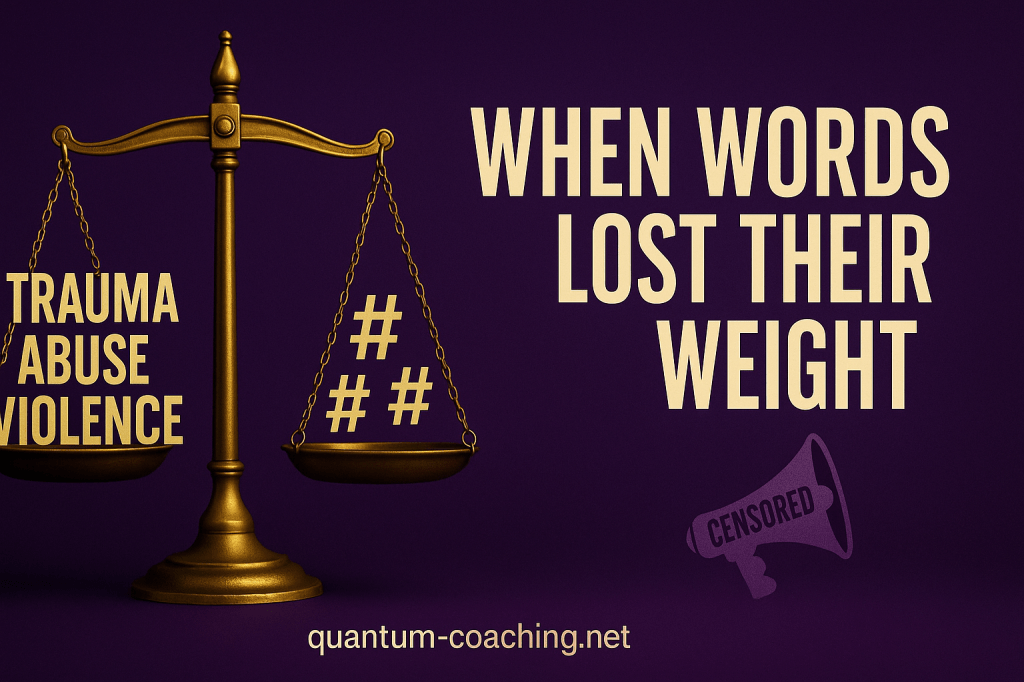
How we inflated trauma, monetized victim-hood, and left actual damage in the clearance aisle
You know what I’m talking about. Words used to mean something. Abuse. Trauma. Violence. Racism. These weren’t lifestyle accessories. Now they’re engagement bait, and the people who’ve actually lived through hell can’t get a word in edgewise.
The Slow Fade
Academics call it “concept creep.” Whatever. Here’s what happened: serious terms got stretched like a sweater three sizes too big. Started with good intentions, recognizing more kinds of harm. Ended with everything being everything until nothing meant anything.
We talk constantly about trauma. We slap labels on everything. We understand jack shit.
The Attention Economy Ate Our Brains
Platforms don’t reward thinking. They reward feeling. Outrage moves faster than reason. Moral panic gets more retweets than “let’s think about this.” It’s not some grand conspiracy. It’s just math. Dopamine math.
The Great Shutting Up
People are scared to say what they actually think. Students won’t talk in class. Coworkers tiptoe around every goddamn topic. When everyone’s terrified of saying the wrong thing, nobody learns anything. No friction, no growth. Just a bunch of people nodding while thinking the opposite.
When the Rules Eat Reality
Consent matters. Obviously. But when the guidelines say “any heavy drinking = no consent,” we’re pretending humans are simpler than they are. Alcohol muddles everything: memory, intention, morning after narratives. Bright line rules protect people, sure. They also flatten every gray area into a felony.
The Story That Breaks the System
Here’s what happened to someone. Real story, both people told it the same way.
Bar at night. Friend group. She’s talking with a guy from the crew. Chemistry, but both too shy to make a move. Drinks happen. Her friends bail at 3 AM, leave her drunk. He walks her home (an hour on foot to keep her safe) to her friend’s place where she’s supposed to crash. Nobody answers the door. She’s stranded.
He offers his couch. She accepts. On the walk, she tries to kiss him three times. He refuses each time. She’s too drunk, he’s not doing this. At his place: “You take my bed, I’ll take the sofa.”
5 AM. She wakes up, walks out naked, sits on him while he’s asleep, starts touching him. He wakes up. She kisses him. They have sex until 10 in the morning. They sleep it off. He walks her back to her friend’s place. They kiss goodbye.
Months later: sexual assault charge. Because she was too drunk to consent. They both were but she used the broken system he didn’t.
Both told the identical story. He turned her down three times specifically because of the alcohol. Gave up his bed. She initiated while he was unconscious. Didn’t matter.
So what’s the lesson here? Don’t help drunk women get home safe? Leave them on the street at 3 AM? That’s what we’re incentivizing. Do the right thing, show restraint, still get destroyed because a rulebook written for predators doesn’t have a category for “complicated human situation.”
This isn’t about protecting anyone. It’s a system that can’t tell the difference between a rapist and someone who gave up his bed and said no three times.
When Everything’s a Crisis, Nothing Is
Call every mean comment “abuse” and actual abuse disappears into the static. Call every bad night “trauma” and real trauma victims wait even longer for help. Make everyone terrified of words instead of actions, and basic human decency dies. Fewer guys walk anyone home. Fewer women accept help when they need it. Everybody loses.
Bring Back the Dictionary
Save the heavy words for heavy situations. Only use “abuse” or “violence” when there’s actual force, coercion, or credible threats. Describe the behavior first. Try “shitty,” “unfair,” “manipulative,” or “regretted” before you jump to DSM-5 territory. Precision isn’t pedantry. It’s honesty.
Context isn’t an excuse for harm. It’s the only way to identify harm. When your framework calls both a violent predator and a guy who slept on his own couch by the same name, your framework is broken.
Why Drama Ate Discourse
Outrage is currency. Calm is bankruptcy. Algorithms want your pulse racing. Public life rewards performance, not resolution. People compete for worst story wins. Real suffering gets crowded out by professional victims.
A Field Guide for Actual Adults
Talk like you have to live with the consequences. Because you do.
The basics:
- Facts over feelings. Receipts over reactions.
- Quote what actually happened before you label it.
- Ask one clarifying question before you broadcast your take.
- Don’t post drunk. Don’t text when you’re sure you’re right.
- Clear verbal yes in private. When alcohol’s heavy, wait. Future you will thank you.
For anyone with a platform:
- Define your terms. Use examples. Show your work.
- Mark opinion as opinion.
- Notice when people are self censoring and fix the climate that caused it.
- Reward de escalation. Reward evidence.
- Stop with the clickbait headlines. Trust takes years to build and seconds to torch.
The Way Forward
Big words for big things. Precision creates fairness. Fairness builds trust. Trust means people help each other when shit gets real. When doing the right thing gets you punished the same as doing the wrong thing, people stop doing the right thing. Simple math.
The Bottom Line
Scars teach. Slogans don’t. People grow through challenge, not through bubble wrap and trigger warnings. The safety sellers deliver silence and call it progress.
Say what you mean. With evidence. With your name attached. Stand behind it.
Censorship doesn’t protect. It suffocates. Draw the line. Own your words.
More truth, less performance art. More spine, less brand management.
Terms that used to signal serious harm, now diluted into everyday complaints
These words once carried weight. They pointed to real damage, real violations, real danger. Now they’re used so loosely that when someone actually needs help, the signal gets lost in the noise.
| Term | Used to mean | Now often used to mean |
|---|---|---|
| Trauma | Deep psychological injury. | Anything that made me uncomfortable. |
| Abuse | Sustained cruelty or violence. | Any unkind behavior. |
| Violence | Physical force intended to hurt. | Words, looks, and disagreement. |
| Assault | Actual physical attack. | Unwanted conversation or awkward moments. |
| Gaslighting | Deliberate psychological manipulation to make someone doubt reality. | Disagreeing with me. |
| Toxic | Poisonous, harmful relationships. | Anything I don’t like. |
| Narcissist | Clinical personality disorder. | Selfish or confident. |
| Triggered | PTSD flashback response. | Mildly annoyed. |
| Harassment | Repeated, unwanted contact meant to intimidate. | Any interaction someone didn’t enjoy. |
| Predator | Someone who hunts victims systematically. | Anyone who asked someone out twice. |
| Genocide | Systematic extermination of a people. | Policy disagreements. |
| Fascist | Authoritarian ultranationalist regime. | Anyone I disagree with politically. |
| Racist | Belief in racial superiority. | Everything from hate crimes to minor insensitivity. |
| Slavery | Forced human ownership. | Bad jobs or capitalism itself. |
| Rape | Forced sexual penetration. | Regretted consensual encounters. |
| Oppression | Systematic cruel authority. | Any inconvenience or criticism. |
| Privilege | Unearned advantage. | Reason to dismiss anyone’s opinion or achievement. |
| Survivor | Lived through life threatening trauma. | Anyone who had a bad experience. |
| Unsafe | In physical danger. | Emotionally uncomfortable. |
| Phobia | Clinical anxiety disorder. | Disagrees with my worldview. |
| Panic Attack | Acute physical anxiety episode. | Feeling stressed or worried. |
| Depression | Clinical mental illness. | Temporary sadness or boredom. |
| Anxiety | Debilitating worry disorder. | Normal nervousness. |
| Bullying | Repeated targeting and intimidation. | Any single mean comment. |
| Terrorism | Violence for political intimidation. | Protests or activism. |
| Nazi | Member of genocidal regime. | Anyone with right wing views. |
| Exploitation | Abusive use of power for gain. | Any employer or employee relationship. |
| Colonialism | Imperial conquest and subjugation. | Cultural exchange. |
| Genocide (Cultural) | Deliberate destruction of a culture. | Any cultural change or influence. |
| Marginalized | Systematically pushed to society’s edges. | Anyone who feels unheard. |
| Systemic | Built into institutional structures. | Happens more than once. |
| Hate Speech | Speech inciting violence against groups. | Any opinion that offends. |
| Microaggression | Subtle discriminatory slight. | Any awkward social interaction. |
| Invalidate | Deny someone’s reality. | Disagreed with me. |
| Harm | Actual injury or damage. | Hearing ideas you dislike. |
| Emergency | Life threatening crisis. | Any inconvenience or strong emotion. |
| Crisis | Turning point requiring immediate action. | Everyday problems. |
| Genocide (Academic) | Mass killing of a people. | Demographic changes. |
| Silenced | Forcibly prevented from speaking. | Criticized for what I said. |
| Erased | Removed from existence or record. | Not centered in every conversation. |
| Dehumanizing | Stripping human dignity. | Any criticism or disagreement. |
| Literal Violence | Actual physical force. | Phrase created because “violence” alone now means words. |
| Genocide (Social) | Destruction of a group. | Social disapproval or reduced representation. |
| Discrimination | Unjust treatment based on category. | Any outcome inequality. |
| Persecution | Systematic oppression and punishment. | Any criticism or pushback. |
| Devastating | Completely destructive. | Mildly disappointing. |
| Annihilated | Completely destroyed. | Criticized or felt bad. |
| Murdered | Unlawfully killed. | Verbal comebacks or criticism. |
| Destroyed | Ruined beyond repair. | Argued against effectively. |
| Censorship | Government suppression of speech. | Platform moderation or social consequences. |


 Quantum-Coaching
Laisser un commentaire