
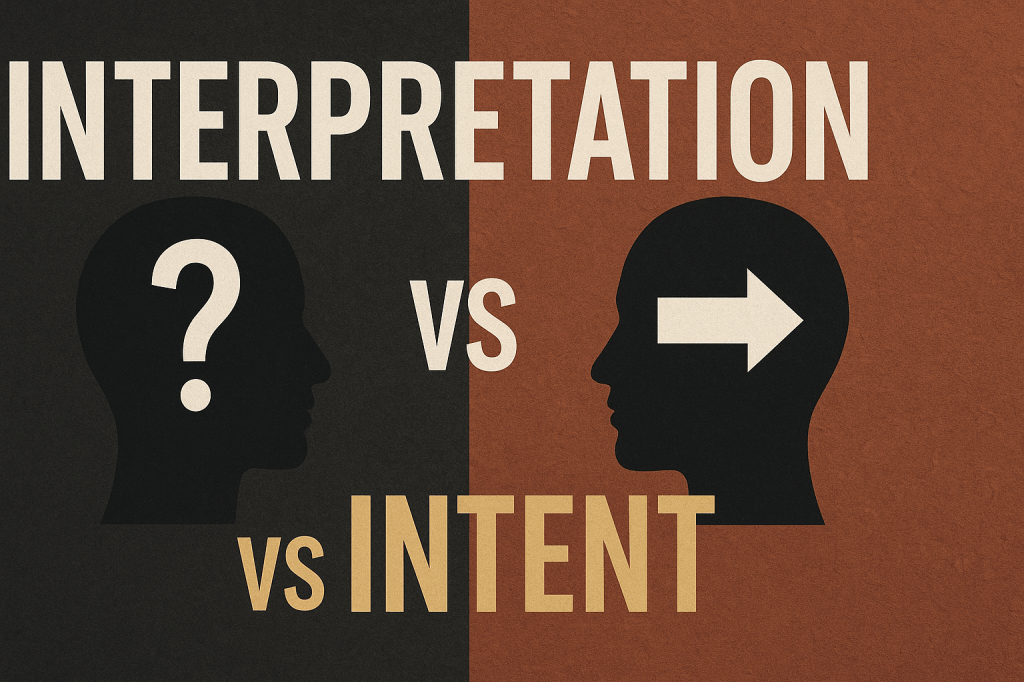
You say one thing.
They hear another.
The gap between the two destroys trust, connection, and basic sociability.
People look for hidden messages where there are none. They search for threats in simple words. They scan interactions with fear instead of presence. This creates a world where every sentence becomes a trigger and every misunderstanding becomes a war.
The problem is not the words.
The problem is the filter.
People read with their wounds, not their ears
Your brain does not hear language first.
Your brain checks for danger.
This is survival instinct.
If someone grew up around rejection, they expect rejection.
If someone got betrayed, they expect betrayal.
If someone was hurt by a man, they expect harm from men.
The brain builds patterns.
Then it seeks proof.
This is confirmation bias.
Tell someone in trauma to “look for crimson red” in their room and they will label every shade of red as crimson.
Tell them to name everything that is sky blue and they miss half of what is there.
Same with communication.
They search for disrespect.
They search for danger.
They search for hidden meaning.
They find it everywhere, even when it never existed.
Example 1: A simple tease turns into an attack
A woman compares her sexual skills and boasts she’s worth “1000 women.”
You tease back with “they all say that” as a playful nudge.
The intent is humor.
The interpretation becomes:
- “You insult all women.”
- “You dismiss me as a woman.”
- “You judge my gender.”
The brain filled in a meaning that was never spoken.
Fear spoke louder than logic.
Who suffers?
Both.
She gets hurt by something that was never harmful.
You get painted as a villain for a joke.
Example 2: Short answers
You text “ok.”
You mean agreement.
They hear anger.
They hear rejection.
They hear coldness.
Intent: neutral.
Interpretation: emotional explosion.
Example 3: Boundaries
You say “I need some time alone.”
You mean rest.
They hear “you don’t matter.”
Intent: self care.
Interpretation: abandonment.
People expect the worst because they were trained to
Modern conditioning teaches people to fear each other.
Men are taught women are not trustworthy, yet you probably trust your mom more than anyone.
Women are taught men are dangerous, yet you are still alive because most men around you never harmed you.
Everyone is taught strangers are dangerous, yet strangers are usually the first to help when you are in trouble.
Everyone is taught silence is dangerous, yet silence heals more than noise ever will.
Everyone is taught discomfort equals danger, yet discomfort is the only path that moves your life forward.
The result:
Nobody listens.
Everybody reacts.
Fear hijacks communication.
The nervous system becomes the author of the conversation.
Your brain filters language through three layers
- Personality.
Direct people sound rude to sensitive people.
Sarcastic people sound hateful to literal people. - Education and culture.
Every culture interprets tone, humor, and silence differently. - Trauma history.
Your past defines what your brain labels as danger.
A harmless sentence can feel like a threat if old wounds are still open.
This creates a world where a single word triggers a whole biography.
People forget one truth
Words are signals.
Actions are evidence.
If actions do not match the fear, the fear is internal, not external.
Stop reading minds. Start reading behavior
Someone who jokes with you is not attacking you.
Someone who speaks short is not rejecting you.
Someone who needs space is not leaving you.
You ruin relationships when you react to your own imagination.
How to stop this pattern now
These steps shift your perception fast.
- Expect the best, not the worst.
You change your energy and attract different behavior. - Ask before reacting.
“What did you mean by that sentence?”
Nine out of ten conflicts die here. - Listen without hunting for hidden meaning.
Not everything carries a secret message. - Pay attention to patterns of action.
Ignore tone.
Observe consistency, effort, and behavior. - Slow your reactions.
Your first reaction comes from your wound.
Your second reaction comes from your truth. - Stop making everything about you.
Most people talk from their own world, not about you. - Remember humor exists.
Sarcasm is not aggression.
Teasing is not disrespect.
Playful tension is not violence. - Understand personality differences.
Direct speakers are not hostile.
Sensitive speakers are not weak.
Misinterpretation often comes from mismatched styles, not bad intent. - Rewire your bias.
Your brain leans toward fear because fear once kept you alive.
Now it destroys your relationships.
Practice asking yourself:
“Is this threat real, or is this old pain?”
This single question changes everything.
The epiphany
Most problems in communication do not come from words.
They come from the story the listener tells themselves.
You change your world the moment you stop assuming the worst.
You shift your energy.
You attract different people.
You stop fighting ghosts in your head.
You start connecting with the humans in front of you.


 Quantum-Coaching
Laisser un commentaire